
Last week, Nvidia announced that Jensen Huang, who co-founded the company 33 years ago and became the public face of the AI boom, was stepping down as CEO, effective immediately. The chief financial officer, Colette Kress, was named interim CEO. The reasons have been widely reported, and they are not the point here.
The point is one sentence in the board's statement: "we expect the company's operations, customer commitments and product roadmap to continue without interruption."
Every owner should read that sentence and ask a hard question. If I stepped out tomorrow, or if my best person did, could anyone say that about my company?
Every growing business has a hero
You know who they are. The owner who carries every key customer relationship. The operations manager who is the only one who really understands the ERP. The estimator whose numbers nobody questions because nobody else knows how they are built. The bookkeeper who closes the month in a way no one has ever written down.
Heroes are good for a business. Dependence on heroes is the risk. Heroes leave for ordinary reasons: retirement, illness, a better offer, burnout, a family move, the sale of the company. They rarely leave with notice that matches what they carry in their heads.
In IT they have a name for this: the bus factor. How many people would have to be hit by a bus before the work stops? In many growing businesses, the honest answer is one.
Why a large company can say "without interruption"
Whatever happens next at Nvidia, the board had something to stand on: a chief financial officer ready to step in, a leadership team, a board, written commitments to customers and a product roadmap that exists on paper.
Most businesses with 20 to 200 people have none of those layers. The owner is the board, the backup and the process manual. When the knowledge lives in one head, the continuity plan is that person's health and goodwill.
The numbers say most owners know this and have not acted yet. In a Chase survey of small business owners published in May, nearly half expected to step away within the next decade, yet fewer than one in ten said they were fully prepared to hand over the business. The biggest barriers they named were time, competing priorities and not knowing where to start.
Documented processes are the continuity plan
Documentation does not mean a binder nobody opens. It means four practical things:
- A one-page map of each critical process: who does what, in what order, with which data.
- The decision rules: how prices are set, who approves what, and how exceptions are handled.
- Where the data lives, and who has access, in company accounts rather than personal ones.
- The customer and supplier relationships, written down and shared with at least one other person.
A simple test: could a capable new person run that process for two weeks using only what is written down?
In 25+ years leading technology transformation in large enterprises, and as a Lean Six Sigma Process Engineer, I have learned one rule that holds everywhere: you cannot improve, automate or hand off a process you have not defined. That includes AI. A tool cannot learn a process that only exists in someone's memory, which is why documenting the work comes before automating it.
Five steps for this quarter
- List your heroes. Name the people whose absence for a month would hurt, including yourself.
- For each hero, name the three processes only they can run today.
- Map each process on one page, with the hero, while they are here. Present it as recognition of what they know, not as a plan to replace them.
- Name a second person for each process, and let them run it once while the hero watches.
- Move logins, files and key contacts into company accounts, so access never leaves with a person.
None of this needs new software. It needs a few hours a month and someone who owns it.
Where Capability Methods helps
This is the core of our work. Our AI and Operations Readiness Diagnostic scores how the business actually runs, including process discipline, through interviews with your people and a review of your tools and workflows. In three to four weeks you get your top gaps in plain English and a Now, Next, Later roadmap. Every engagement is built to hand off: it ends with something your team can run without us.
If one or two names came to mind while you read this, that is a good place to start.
A note for advisors
Wealth managers: a succession plan assumes the business can run without its owner. Insurance brokers: key-person cover pays money, but it does not transfer knowledge. Bankers: you already price this risk when you lend. CPAs: you see it when the close depends on one bookkeeper.
Your involvement matters more than you may think. The same Chase survey found that owners who did not work with an outside expert, such as a banker, were four to eight times more likely to remain stuck in early planning.
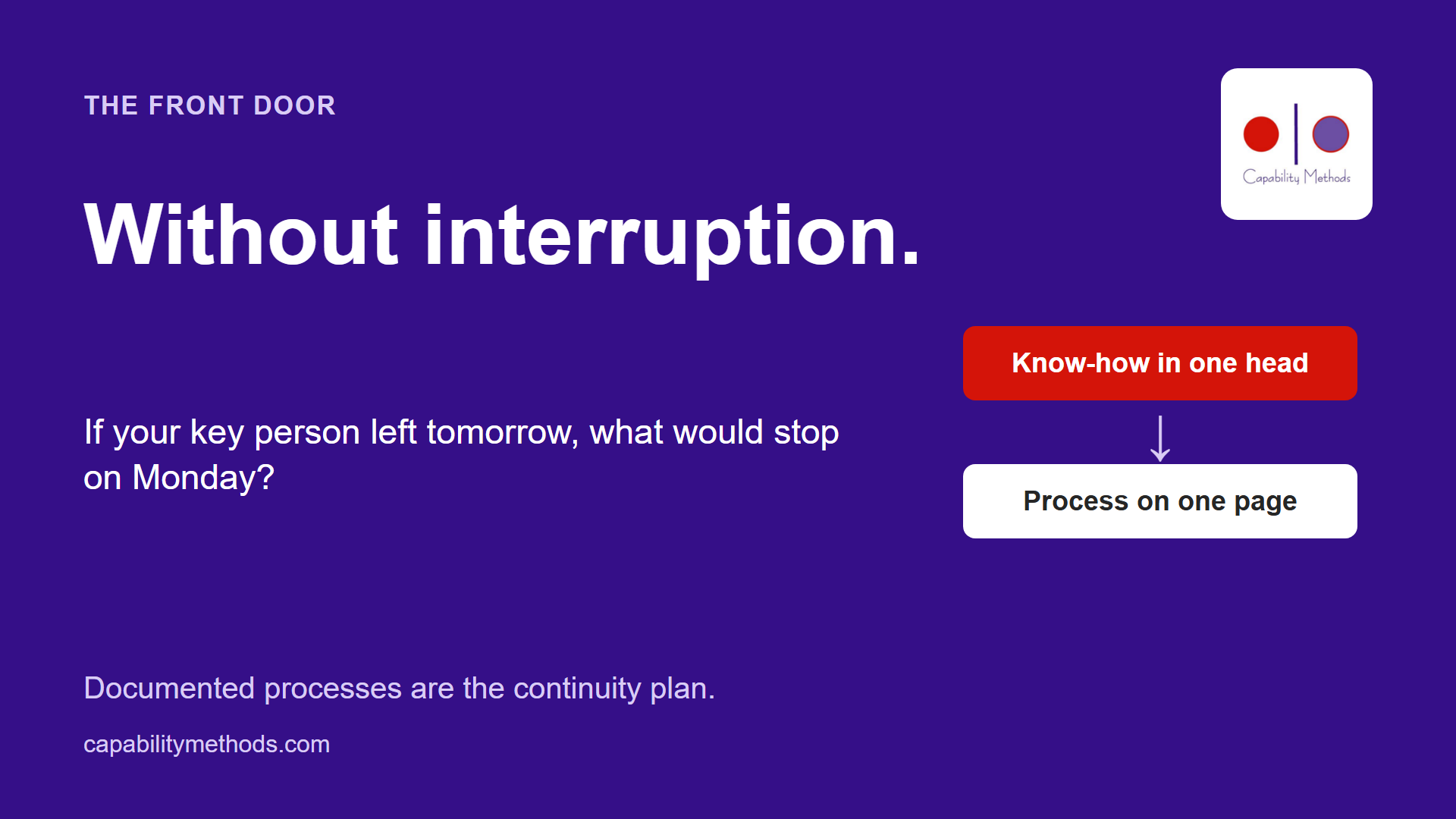
One question opens the conversation with a client: "If your best person left on Friday, what would stop on Monday?"
The question for you
Nvidia will find its next CEO, and the business will keep running because it was built to. Who is the hero in your business, and is what they know written down anywhere?
Sources: CNBC, "Nvidia live updates: CEO Jensen Huang resigns, Colette Kress named interim chief," 12 November 2026, and Nvidia's announcement quoted there; Chase for Business small business succession survey, published 4 May 2026.